SHORT ANSWER
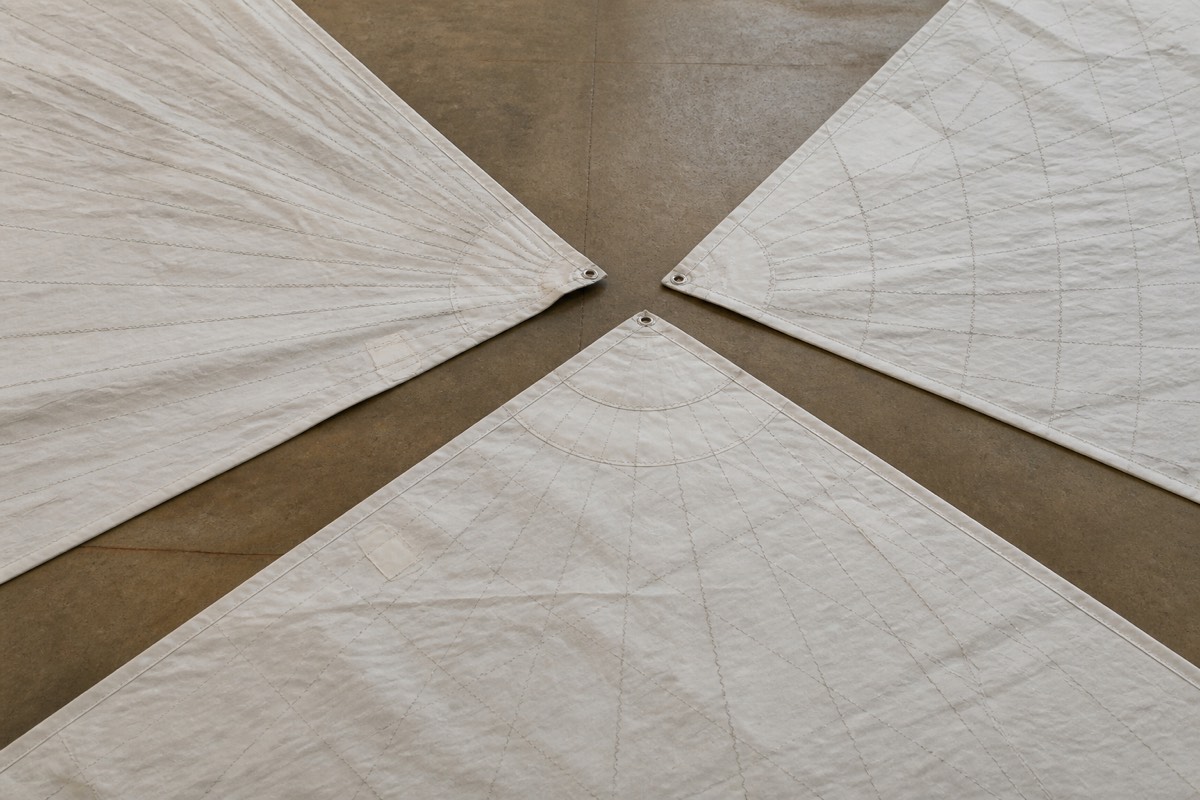
Crosscut sails place their principal seams broadly across the sail. Radial sails fan panels from load areas so selected cloth directions can follow those loads. Neither layout is a quality grade; cloth properties, shape, reinforcement, stitching and execution determine the useful result.
Three checks before you act
- 01Trace loads from head, tack and clew before comparing panel names.
- 02Ask which cloth direction carries each major load.
- 03Inspect seams and corner transitions as one connected structure.
Start at the corners and follow the force
A sail is pulled at its corners and supported along edges, slides, battens and reef points. Those forces spread through cloth and seams rather than staying on a diagram line. In a crosscut layout, panels generally run across the sail and the designer selects a cloth whose useful direction works with that arrangement. In a radial layout, narrower panels can fan from the head, tack or clew so a preferred yarn or fiber direction follows important loads more directly.
That description explains geometry, not outcome. A well-designed crosscut cruising sail may prioritize stable woven cloth, familiar construction and serviceability. A radial sail may use a warp-oriented woven product or a laminate selected for directional strength and low stretch. Dimension-Polyant's Pro Radial range is explicitly a woven polyester cloth made for radial layouts, which is a useful reminder that radial does not mean laminate and woven does not mean crosscut.
Panel count has costs as well as benefits
More and narrower panels let a designer steer material directions and shape in finer steps, but they also create more seams and more transitions to construct and inspect. The relevant question is whether the complete layout uses those seams purposefully. Look at how panels meet reinforcement, how the leech and foot are stabilized and whether abrupt changes concentrate strain. A photograph of the full sail plus close views of the corners says more than counting rays from the clew.
Construction choice also affects repair. A straight local seam in a familiar woven cloth may be straightforward for a capable loft to assess. A damaged radial panel can cross several load paths, and a laminate repair may need material and process knowledge that an onboard patch cannot reproduce. Ask the builder how a panel is replaced, what visual signs call for inspection and whether the proposed cloth is supported by a loft where the boat normally sails.
Compare designs with the same brief
Give competing sailmakers the same dimensions, rig details, reef plan, target use and handling priorities. Ask each to explain the proposed panel layout in plain language: where the major loads run, which cloth direction carries them, how corners spread force and what trade-off the design accepts. A drawing or marked photograph is more informative than a premium-sounding cut name. It also gives the owner a baseline for later inspection and repair discussions.
Once the sail is in service, inspect seam alignment, stitching, corner transitions and shape under repeatable conditions. Record unusual wrinkles that persist after normal trim, localized distortion around a seam and wear where multiple layers end. Do not diagnose the cause from a single crease while the sail is badly trimmed. Compare both tacks, note the wind and control settings, and ask the loft when the pattern repeats under the conditions for which the sail was designed.
BOUNDARY
A panel pattern is not a performance certificate
Crosscut and radial describe construction geometry, not guaranteed speed, longevity or suitability. Any separation, torn seam, distorted corner or unexplained shape change at a load path needs direct review before the sail is loaded again.
Read layout with cloth and wear
First compare cloth constructions, then record new and changing seams with the inspection workflow. The Sail Fit Matrix keeps use and handling beside the panel decision. Crosscut and radial panels answer the same question in different ways: how to align cloth threads with the loads a sail carries. The same habit of matching structure to load appears in other precision sports, where distance and rules decide the equipment. Swiss crossbow sport, shot at 10 m and 30 m, sets its own distances, safety roles and club structure, and the national federation explains how a match season run is organised, including coaching and youth protection. Reading that page alongside this one shows how measurement and control govern both cloth and range. Sail layout and river reading share the same habit of attention. A crosscut panel spreads load along the warp, a radial panel redirects it toward the corners, and both reward a builder who watches how force actually travels. The same patience applies on moving water, where reading seams, pockets and current lines decides the cast. Anglers working the McCloud and Upper Sacramento below Mount Shasta face that problem directly, and a self-guided plan for water without spooking fish covers insects month by month, pocket-water technique, flow, clarity, temperature, access and camping.
SOURCES AND DATE
Checked 25 August 2026. The Pro Radial page supports the existence of warp-oriented woven cloth for radial sails; product claims are not treated as comparative test results.